Blueprint deepens its Warner Bros. licensing deal with a second Westeros title
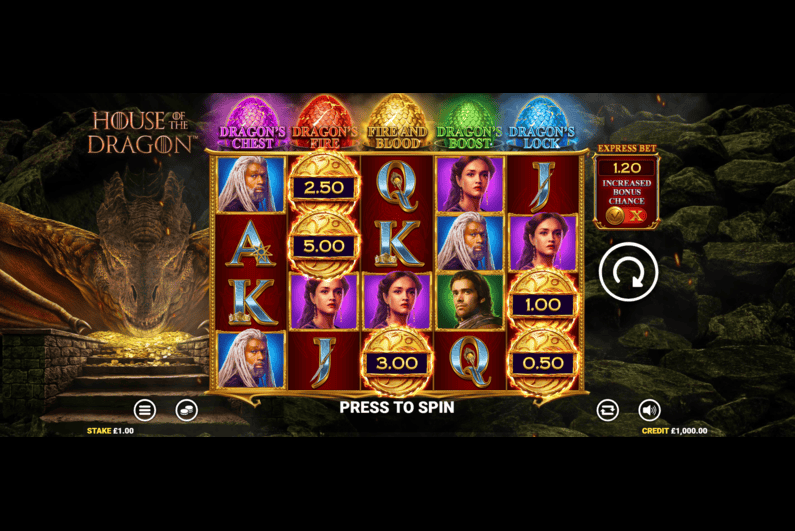
Blueprint Gaming has released House of the Dragon, its second slot drawn from the Game of Thrones universe. It’s the latest product of a licensing agreement with Warner Bros. Discovery Global Experiences (WBDGE).
The launch matters less as a single game than as confirmation of intent. Blueprint is executing a multi-title roadmap around one of television’s biggest franchises, rather than treating the license as a one-off.
The studio confirmed the WBDGE deal earlier this year, framing it as a long-term series of premium, IP-led releases. The agreement also includes future titles inspired by House of the Dragon, forming part of a long-term roadmap of premium, IP-led releases.
House of the Dragon is the first House of the Dragon-branded title to arrive from that roadmap, following the debut Game of Thrones slot. The sequencing signals that Blueprint intends to work the license methodically across the broader Westeros catalog rather than exhaust it in a single flagship game.
Why the timing follows a record Game of Thrones launch
The commercial logic behind a quick follow-up is clear from the performance of the first game. According to Blueprint, its Game of Thrones slot became the studio’s strongest global launch in company history across seven of its ten leading markets.
That kind of result gives Blueprint a strong reason to move fast on a companion title while player interest in the franchise remains high. House of the Dragon extends the same IP into a new corner of the fiction, drawing on the HBO prequel’s Targaryen storyline and its central conflict, the Dance of the Dragons.
Alex Naspe, Blueprint’s marketing director, tied the release directly to that momentum. “Following the fantastic response to Game of Thrones, we were delighted to bring another iconic corner of Westeros to life with House of the Dragon,” he said.
The messaging positions the two games as part of a connected series rather than standalone products. That’s consistent with how Blueprint originally described the WBDGE partnership.
A familiar engine under a premium skin
Beneath the licensed presentation, House of the Dragon leans on mechanics Blueprint has used before. The game is built on the studio’s money-collect framework, and its structure closely mirrors the earlier release Red Hot Catch, which Blueprint lists as its family-tree reference.
That reuse is the most telling product detail for anyone tracking Blueprint’s approach. The studio has consistently paired recognizable entertainment brands with proven, established math models rather than building new engines for every license; House of the Dragon fits that pattern squarely.
The core proposition centers on a cash-collect mechanic, with a Dragon’s Wheel feature and a set of Syrax-themed base-game modifiers feeding into a Dance of the Dragons free spins round. The first game in the series is built on Blueprint’s most popular money-collecting mechanic, with an array of base-game modifiers.
Blueprint invests heavily in securing and presenting a marquee license
For experienced players, the significance is not the individual features but the strategic tradeoff. Blueprint invests heavily in securing and presenting a marquee license, then applies a tested collector engine to keep development risk low and appeal broad. The game targets money-collect and feature-upgrade players, a segment Blueprint’s existing catalog already serves.
The math profile reinforces that the game is aimed at accessibility rather than extremes. House of the Dragon tops out at a 3,000x max win, with RTP configurations ranging up to 94%, a spread that lets operators select their preferred return model.
What availability tells us about the target audience
The launch footprint underlines that Blueprint is treating this as a regulated-market release rather than a niche drop. The game is available across mobile, tablet, and desktop, and is certified for a wide slate of licensed jurisdictions, including the UK, Malta, Sweden, Denmark, Italy, Spain, the Netherlands, and Brazil.
That breadth matters commercially. A premium HBO license only earns its cost when it can be distributed widely; certifying House of the Dragon across multiple major regulated markets at launch gives operators in each territory a recognizable brand to feature.
Brazil’s inclusion is notable given the market’s continued formalization. That positions the title to reach one of the fastest-developing regulated audiences alongside established European markets.
What the roadmap signals about Blueprint’s branded pipeline
House of the Dragon reinforces a strategy Blueprint has built its reputation on: translating globally recognized entertainment properties into commercially durable slots. The new partnership builds on Blueprint Gaming’s long-standing heritage in developing IP-based slot content.
The studio’s own framing of the deal stressed brand stewardship as much as gameplay. Charlie Jacka, head of product at Blueprint Gaming, said: “Game of Thrones is one of the most significant entertainment brands in the world, and working with an IP of this scale carries a clear responsibility.”
the Game of Thrones universe is becoming a recurring fixture in Blueprint’s release schedule
The WBDGE agreement is explicitly structured to span multiple releases. So House of the Dragon reads as a checkpoint rather than an endpoint. Blueprint has now demonstrated it can extend the license beyond the flagship title, and its roadmap language suggests further Westeros-themed games are likely to follow.
For operators, that points to a steady stream of instantly recognizable branded content from a single supplier. For players, it means the Game of Thrones universe is becoming a recurring fixture in Blueprint’s release schedule rather than a single seasonal event, with familiar collector mechanics carried across each new entry in the series.