One symbol, one trigger: what Play’n GO actually changed
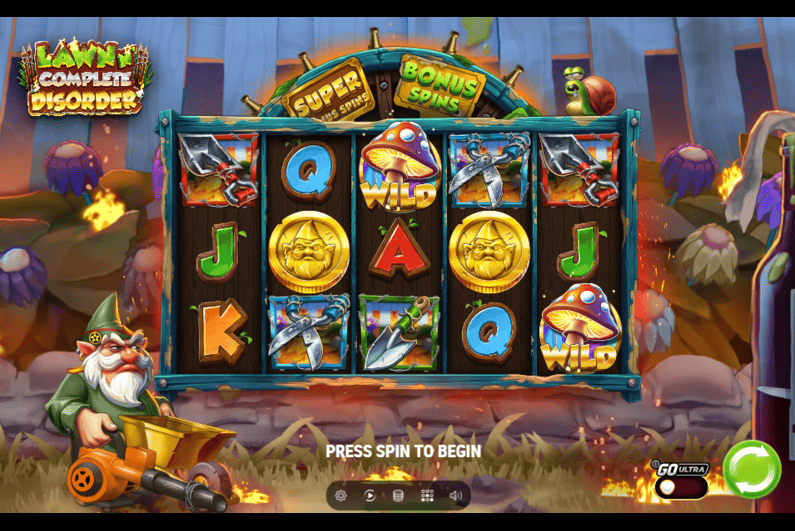
Play’n GO has gone live with Lawn n’ Complete Disorder, a 243-ways video slot whose defining feature is structural rather than thematic. The studio has routed its entire feature set through a single Coin symbol.
The design decision matters more than the garden-war premise. Coins can award an Instant Bonus, open Hold & Spin, or launch one of the wheel-driven Bonus Spins modes. That gives the whole feature set one consistent trigger.
That consolidation is the news hook. Rather than spreading activation across scatters, dedicated bonus symbols, and separate triggers, Play’n GO has made one symbol responsible for every route into a feature.
Everything runs through Coins. The Coin connects the four Instant Bonus tiers, Hold & Spin, and the two wheel-driven Bonus Spins modes, giving a busy feature set a single point of entry.
For an experienced slots reader, that’s the “so what.” A game with several distinct bonus paths that a player can still read at a glance.
Why a single-trigger structure works for players and operators
Play’n GO’s own framing points to the commercial logic behind the choice. “The Coin carries the game. It pays on the spot, it locks into Hold & Spin, it builds multipliers in Bonus Spins. Operators get a game players read quickly, and GO Ultra changes what the wheel can land,” said Magnus Wallentin, Games Ambassador at Play’n GO.
The observation about readability is the strategic point. Feature-dense slots can overwhelm newer players, and a shared trigger reduces the number of mechanics a player must track before understanding how the game rewards them.
The Coin also does more than open features. Six Coins open Hold & Spin with three Re-Spins, where Coins are the only symbols that can land. In that mode they lock into place, reset the respin counter with each new landing, and pay out their collected values when the respins run out. It’s a familiar Hold & Win framework kept intact rather than reinvented.
Players give up the standard mode to access a higher-variance version with steeper multiplier growth
The optional GO Ultra layer is where the release differentiates itself from a routine Hold & Spin title. GO Ultra is the step up. Activating it removes standard Bonus Spins from the feature pool and introduces Super Duper Bonus Spins, with Coins concentrated on fewer reels and multipliers that grow in larger increments.
The trade-off is deliberate. Players give up the standard mode to access a higher-variance version with steeper multiplier growth. The game carries high volatility, which positions GO Ultra as the risk-forward option inside an already volatile math model.
How the release fits Play’n GO’s character-led catalog
Lawn n’ Complete Disorder is less a departure than a continuation of a format Play’n GO has been building for some time. The studio has repeatedly paired a recognizable comic character with a feature-heavy engine, and Frank the gnome is the latest in that line.
The developer says Lawn n’ Disorder combines character-driven humor with dynamic mechanics, a formula previously used in titles such as Leprechaun’s Vault and Buildin’ Bucks. The studio positions the release within its “Fun Slots” category, which includes titles like Gemix and Tower Quest.
That lineage is the wider takeaway. Play’n GO is treating personality and humor as a repeatable content pillar, not a one-off gimmick, and Frank’s suburban garden feud reads as another entry in a deliberately recurring style.
The premise leans into that identity. “Frank is outnumbered in his own garden and refuses to accept it, and that came through in the artwork early,” Wallentin said, describing a setting in which a grumpy gnome defends his lawn against the gang next door.
the release signals a provider comfortable iterating on both a familiar mechanical family and a familiar creative template
Humor works here as a differentiator in a category crowded with interchangeable Hold & Win releases. By giving the Coin mechanic a clear narrative wrapper, a besieged gnome plus flames and flying objects, Play’n GO gives operators a title with an on-screen hook that needs little explanation.
The commercial argument is straightforward. The commercial hook sells itself on screen: Frank, the gnome gang over the fence, and a suburban garden turned battlefield.
Taken together, the release signals a provider comfortable iterating on both a familiar mechanical family and a familiar creative template. The single-Coin structure keeps a multi-feature game legible; GO Ultra supplies the higher-variance ceiling that engaged players look for; and Frank extends a character-first approach that Play’n GO has increasingly used to distinguish its output from the wider Hold & Win field.