Wicked Games leans further into its irreverent identity
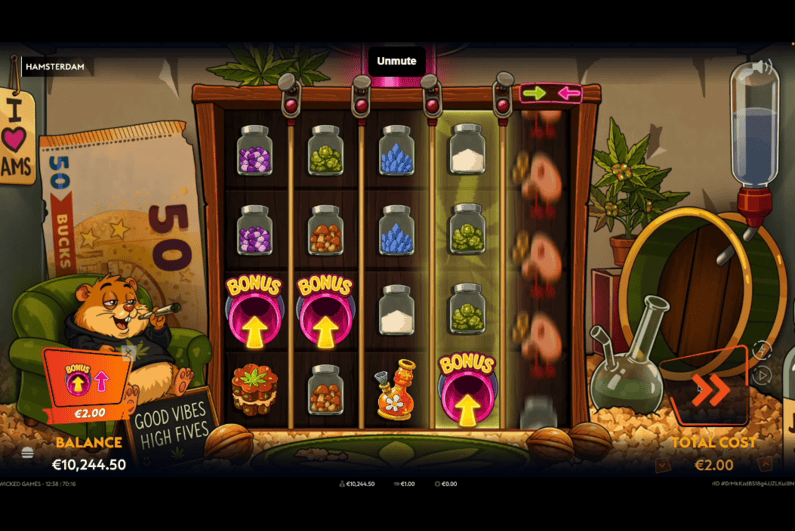
Wicked Games has added Hamsterdam to its catalog. It’s a comedy-driven hold-and-win slot, and it continues the studio’s move away from conventional slot themes.
The release matters less as a standalone game than as further evidence of a deliberate positioning strategy. Wicked Games has increasingly built its identity around provocative, adult-oriented humor. Hamsterdam sits squarely in that lane, trading fantasy and fruit motifs for a cast of stoner hamsters, pimps, madams, and strippers.
For an experienced slots reader, the point is straightforward. In a market crowded with interchangeable mythology, candy, and Egyptian themes, Wicked Games is betting that distinctive, boundary-pushing theming is itself a differentiator.
A theme built to stand apart
The core proposition of Hamsterdam is tonal rather than mechanical. It runs on a 5×4 grid with 20 paylines, carries a 96.1% RTP, and sits at the top of the volatility scale. Those figures are conventional enough that they aren’t the story.
What sets the release apart is the willingness to build an entire slot around adult-themed comedy. The base game frames a drug-addled hamster in a leaf-print hoodie, and triggering the bonus shifts the action to a red-light district populated by suitably unconventional characters.
a recognizable house style that players either seek out or avoid
That decision carries an obvious trade-off. Theming this pointed narrows the audience, since its appeal comes down to personal taste. But it also gives Wicked Games something most volume studios lack: a recognizable house style that players either seek out or avoid, rather than one more forgettable release.
The humor also does real work in structuring the game. The two phases are tied directly to the theme, with a laid-back base game and a rowdier bonus. That reinforces the studio’s comedic framing rather than layering it on top of a generic engine.
Familiar hold-and-win math under the comedy
Beneath the irreverence, Hamsterdam runs on a well-understood framework rather than a novel engine. The headline feature is the Upstairs Bonus, a hold-and-win round that concentrates most of the game’s payout potential into bonus play and reserves the 10,000x ceiling for that mode.
The mechanic follows a familiar collect-and-lock template. Nut symbols carry values, an expanding grid unlocks additional positions, and a rotating set of character modifiers adjusts, multiplies, sticks, or collects those values before the round pays out. Big-value symbols do most of the heavy lifting, with the character effects layered on top as accelerators rather than the main driver of outcomes.
That choice is telling. Rather than pairing an unconventional theme with an equally experimental math model, Wicked Games has anchored Hamsterdam to a hold-and-win structure that players and operators already understand. The novelty is front-loaded into the presentation, while the underlying mechanic stays legible.
The base game leans on a lighter respin feature. When two scatters land, they convert to sticky wilds and award respins that pay both ways until no new wilds appear. A modest hook. It’s positioned to keep the base game moving between bonus triggers rather than to carry the game on its own.
This is a studio willing to take creative swings that most of the market avoids
Wicked Games also offers a bonus-buy suite and an ante-style booster, aligning the release with current commercial norms. These options give players a variety of ways into the Upstairs Bonus, which is where the game’s headline potential lives.
The overall design reads as a deliberate balance: distinctive on the surface, conventional under the hood. That combination lowers the learning curve for a theme that might otherwise feel niche, and it makes Hamsterdam easier for operators to slot alongside more mainstream hold-and-win titles.
The result is a release that develops the studio’s creative identity without demanding that players relearn how a game works. For a studio still building recognition, pairing bold theming with familiar math is a reasonable way to stand out while keeping the product accessible.
Whether the approach converts into lasting shelf space will depend on how operators and players respond to Wicked Games’ increasingly provocative output. For now, Hamsterdam confirms the direction. This is a studio willing to take creative swings that most of the market avoids, backed by mechanics conservative enough to keep those swings commercially viable.