Ghost in the machine
In his 1949 philosophical masterpiece, The Concept of Mind, Gilbert Ryle coined the phrase “ghost in the machine” as a critique of Cartesian dualism. It was a way to mock the idea of a disembodied mind steering the physical body like a pilot, exploding the notion of separate, ethereal forces that float above physical reality. He argued that thinking of the mind as some unpredictable spirit trapped inside a body was a category mistake, a way of speaking that made explanatory trouble for philosophy. The ghost was, in fact, just poor language for complex human behavior entwined with the body itself.
the sense that we are, at times, haunted by invisible forces which drive our decision making
Poker players have their own phantoms. We talk about intuition, “spider senses,” and something feeling “off” in a hand. Our choice of language can give the sense that we are, at times, haunted by invisible forces which drive our decision making beyond one’s own strictly logical circuitry. However, just like Ryle’s criticism, the truth is less mystical and more mechanical.
There is no spirit guiding the sick fold, the hero call or big, above-the-rim bluff. There are only patterns, histories, choices, and consequences interacting in a system. When poker players mistakenly treat their decisions as coming from some separate “instinct” or mysterious inner voice, they risk blinding themselves to the real machinery at work. In online poker, though, there is a violation that literalizes the metaphor of the ghost in the machine.
Ghosting on GGPoker
When the “one player, one hand” rule is breached, we call it ghosting, and contrary to what some may think, it is as serious a form of cheating as any other and more serious than most. It is absolutely fundamental to poker that each decision reflects the thinking of the registered competitor and nobody else. In late 2025, GGPoker identified two instances where this principle was violated.
On November 9, an account called “Hinaru” played Day 1 of the GGMillion$ tournament, ultimately reaching the final table as chip leader while being played by someone other than the registered owner. GGPoker discovered the foul play and blocked the account before the final table began. The site also put out a statement explaining that the person operating the Hinaru account was also blocked and permanently banned and that the confiscated funds totaling $115,752 would be redistributed to the affected players.
Just one month earlier, there was another, even more high profile instance of ghosting on GGPoker. On that occasion, a player known as “RealOA” won $346,903 on the GGMillion$ final table, only for it to later emerge that he had received real-time advice from GGPoker ambassador Ren Lin and others via a group chat. On its face, this scandal was about a high-stakes player crossing a clear line by giving in-game coaching and, considered through a Rylean lens, was about hidden agency.
The indefinite ban
The Ren Lin ghosting scandal reverberated around the poker world. RealOA was permanently banned from GGPoker and all its partner platforms, and his remaining account balance was seized and redistributed. Lin was disqualified from the WSOP Circuit event in Cyprus that he was in the middle of playing and indefinitely suspended from GGPoker, WSOP and affiliated networks. He also contributed personal funds to cover the shortfall in prize redistribution.
undermined what had appeared to be a strong stance on cheating by GGPoker/WSOP
The story, however, took a problematic turn when, just seven weeks later, the WSOP lifted the ban on Lin so that he could participate in their Paradise festival in the Bahamas. His reinstatement, with no explanation offered, undermined what had appeared to be a strong stance on cheating by GGPoker/WSOP. A further worrying development ensued when, just one month later, WPT Global decided that they liked the cut of his jib, announcing him as an ambassador.
Not only was this a worrying development, but it had real world, real-time implications for me and my long-term collaborator, Dara O’Kearney. We were both ambassadors for WPT Global and we had both been vociferous on what Lin had done on our WPT Global sponsored podcast, “The Chip Race.” For additional context, let me flash back to December 31, 2025.
“The Lock-In”
On New Year’s Eve, Dara and I released an episode of “The Lock-In” featuring PokerNews Managing Editor Will Shillibier. It had been recorded the day before and had an “End of the Year” theme, picking up on a few of the game’s bigger stories from 2025. Our fourth story was about the WSOP allowing deals at the WSOP bracelet events in the Bahamas, from which we segued to some rather frank takes on the WSOP’s lenience toward admitted cheater Lin, whose “indefinite ban” only lasted until the beginning of the very next tournament.
On the January 4, we released a clip from the show which highlighted both of our takes on Lin and within 45 minutes, we were asked by WPT Global to take it down because there was a possibility that WPT Global’s Asia team might work with him in the future. We removed the clip, but made it clear that we would not under any circumstances pull the episode and that we needed a meeting immediately to discuss this development and the censorship of our work in general.
The meeting was scheduled for the next day and, in the meantime, we were offered what was deemed to be “context.” We were told that Ren Lin’s situation was more subtle and nuanced than had been reported in Western media and after an investigation conducted by WPT Global’s Asia team, it was decided that he was someone with whom they could work.
The meeting
At the meeting, we made it very clear that should Ren Lin join the company, we would leave immediately. We were told that it was only a possibility, if it did happen it was likely far off, and if it did happen, it would likely be his agency working with one of our Asian affiliates. We reiterated that any association between him and WPT Global would result in our departure and the meeting ended there.
Flash forward to 5:30pm GMT on Sunday, January 11, and the WPT Global Twitter account announced Tony “Ren” Lin as their newest ambassador with a “Welcome to the Team” message. By 6pm, I had removed all mentions of WPT Global from my social media and all ‘”The Chip Race” accounts.
To say that Dara and I were angry is an understatement. We felt betrayed by the company who knew our position yet gave us no prior notification. Instead, they chose to release this bombshell at peak poker playing time on a Sunday, when we would be least agile to react. Dara was playing live and I was playing online. Once again, a request was made for an immediate meeting, a request which fell on deaf ears.
The announcement
Five hours later, Dara and I were finally able to speak with one another, by which time the infighting had begun between the different prongs of the WPT family. At approximately midnight, the WPT account had distanced itself from the Ren Lin announcement in this since-deleted tweet:
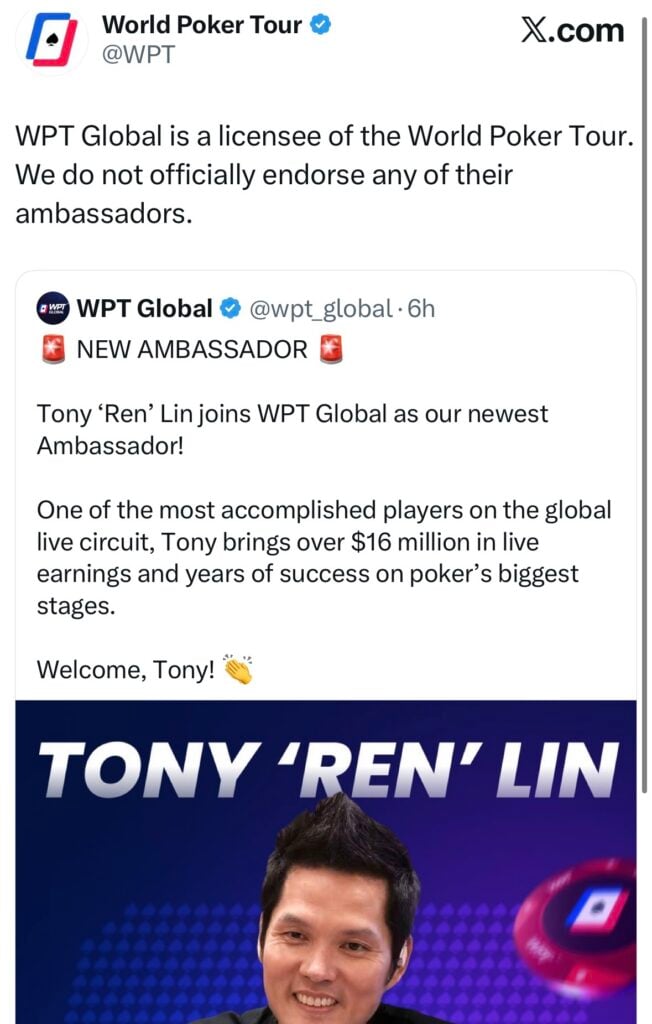
The ClubWPTGold Twitter account expressed its disdain with another since-deleted tweet:
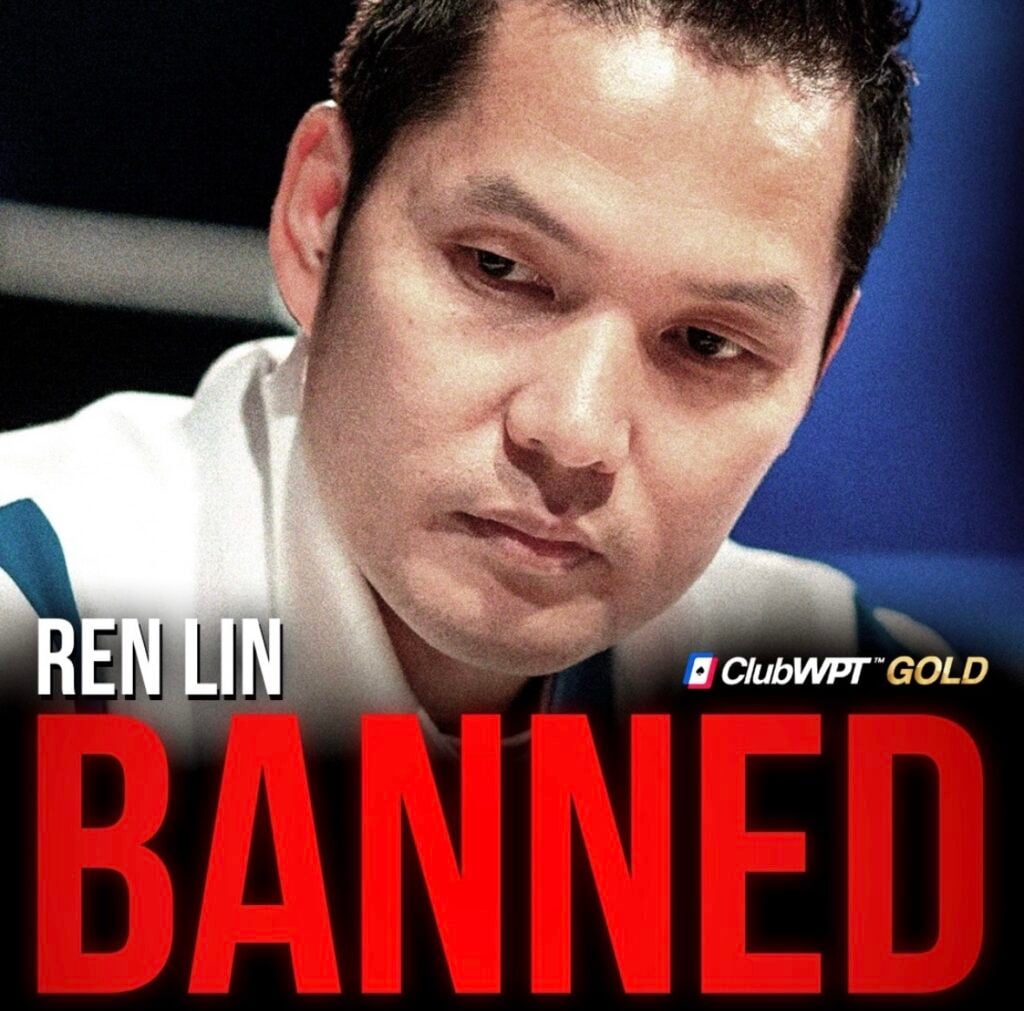
At approximately 6:30am on Monday morning, the tweet announcing Lin as ambassador was deleted, taking with it all the disapproving replies. We hoped that WPT Global had seen sense. We wondered if perhaps the overwhelmingly negative response to the decision on social media and the obvious disapproval from the other WPT companies had prompted, at the very least, a rethink and maybe a change of heart.
WPT Global doubles down
Those hopes were dashed by midday on Monday when the WPT Global account quote-tweeted the ClubWPTGold tweet:
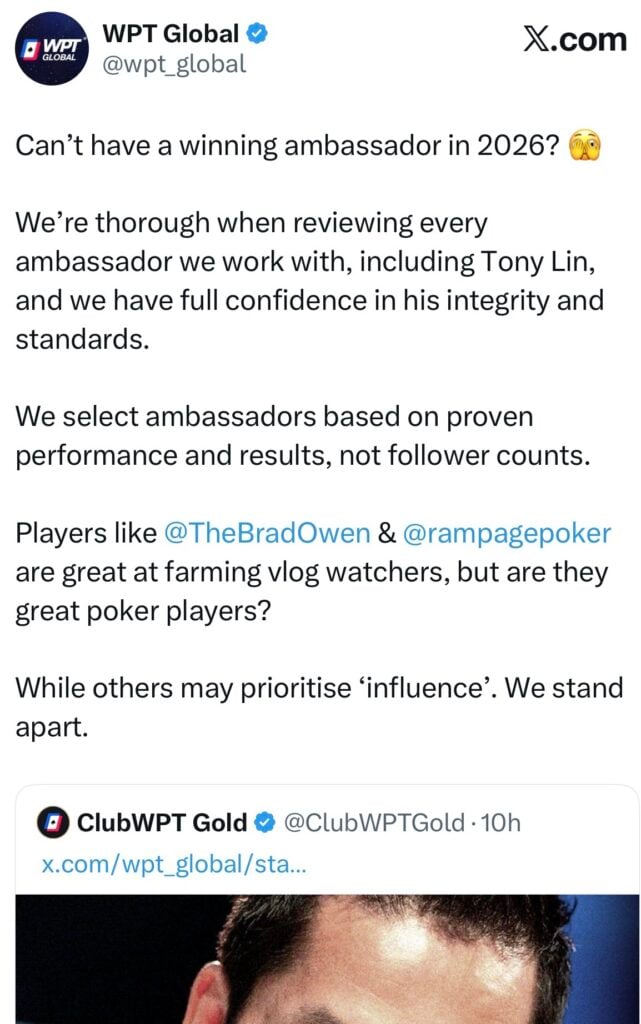
At 12:30pm, that tweet was taken down. Again, we wondered if somebody high up in the company was questioning the wisdom of working with an admitted cheater. It wasn’t to be, and at 12:40pm, a similar tweet was posted, one which spared the ludicrous strays caught by Club WPT Gold ambassadors Rampage and Brad Owen:
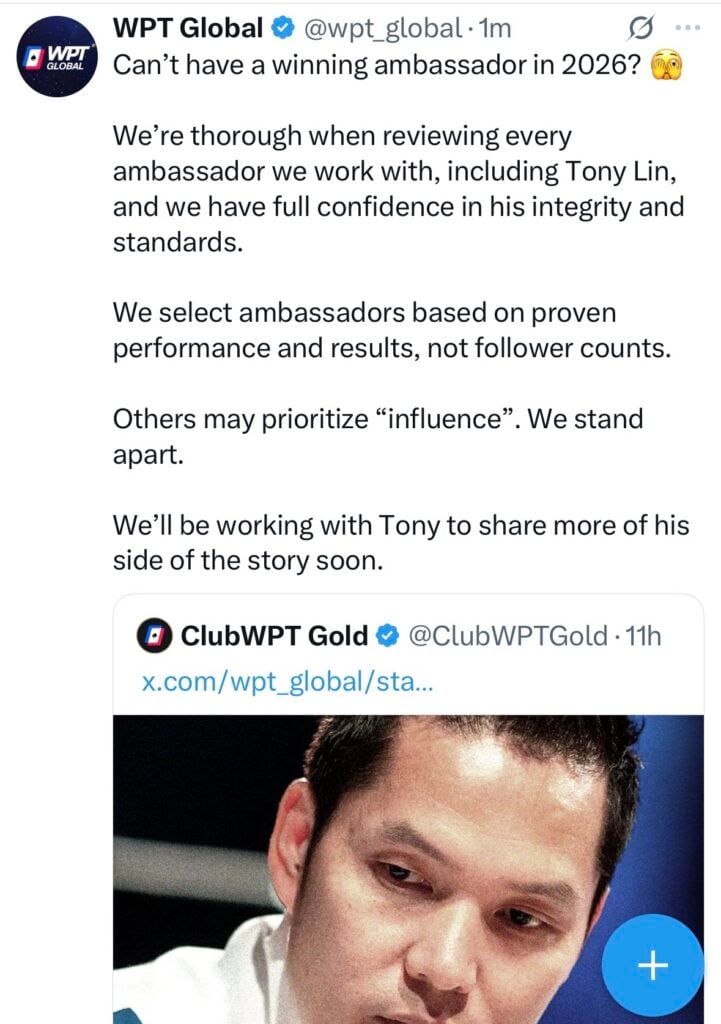
Moments later, the original Ren Lin Ambassador announcement tweet was re-upped:
Then, at 3pm, WPT Global released a bizarre defense of its decision to sign Lin in a statement which read:
“At WPT Global, we believe in the principles of growth, accountability, and redemption. The world of competitive poker is not only about winning hands, but also about personal evolution and the courage to face challenges with integrity.
We are honored to welcome Tony Lin as our newest brand ambassador. Tony has openly addressed past controversies, taken full responsibility for his actions, and accepted the consequences with humility. His willingness to learn, improve, and move forward demonstrates a maturity that aligns with our values. His journey reflects resilience—a quality we admire and wish to highlight. We recognize that people can learn from their experiences and contribute positively to the community.
WPT Global remains dedicated to maintaining the highest standards of integrity, security, and fairness in online poker. Our decision to collaborate with Tony is rooted in our belief in second chances and our focus on the future. We stand by our platform, our players, and our ambassadors as we continue to foster a respectful and trustworthy poker environment.
We look forward to Tony’s positive contributions and encourage our community to join us in supporting growth, both at the tables and beyond.
Thank you for your trust in WPT Global.”
Our line crossed
It was obvious to Dara and I that this statement, which bore all the hallmarks of AI-generated content, was a hastily flung together, desperate attempt by WPT Global to get their arms around the mess that they had made for themselves. The initial release had been completely bungled and given what we were told about the intention to quietly use Lin’s agency, it is very plausible that his announcement was actually made in error. It is also pretty obvious that partnering with him was not done in consultation with the wider company. The entire fiasco spoke volumes to a culture of incompetence.
reputational damage to us which would be made worse by further delays
At 4:40pm, Poker Org published a piece which invoked my December article here on this site that criticized Lin, GGPoker, and the WSOP. It was at that point that Dara and I demanded a meeting with WPT Global’s upper management, citing reputational damage to us which would be made worse by further delays. Within 40 minutes, that meeting was granted.
At the meeting, we asked repeatedly about the lost subtlety and nuance in the western media regarding Lin’s confession. We pressed on what extra information beyond what was in his own statements was out there. We read out Lin’s own words about how 90% of Chinese players ghost. We asked how that could be nuanced into a less terrible defense. There were numerous attempts to prevaricate and talk around our direct question. In the end, all they could say was that there was a good business case for signing Lin.
Mutual termination
Dara and I explained that it was impossible for an ambassador to recommend a site that was welcoming potentially hundreds of his players, 90% of whom, by Lin’s own estimates, would cheat. We made it clear that the company had put us in an untenable position. We reminded them of the clear line that we set and how they had not just crossed it, but crossed it without giving us the courtesy of some notice.
Management then asked us if we wished to resign but having read our contracts thoroughly ahead of time, we knew that this would be considered a default, leaving us open to a potential lawsuit. They then offered us a mutual termination which we immediately accepted. The most important thing for us was to be disentangled from WPT Global with our reputations and that of “The Chip Race” intact.
The next morning, we put out our statement:
For Dara and I, it was a costly decision, but it was not a difficult one. We said what we said about Lin because that’s what we believe and we knew that it would be the height of hypocrisy to stand by as he became a fellow ambassador. We simply could not give our tacit approval to that decision by staying.
There is a difference
Ryle’s contempt for the ghost in the machine was not just a witty phrase. It was a criticism of theories that smuggle unexplained forces into systems where they are not needed. For philosophy, it was about rejecting supernatural explanations of mind. For poker, the ghost is more literal and more pernicious. It is the idea that someone unseen can control a player’s decisions, and thus the outcomes of the game.
getting a pass from WSOP and WPT Global because he represents a value proposition
With that in mind, any kind of ghosting is bad, but the specifics of this incident are especially bad. My hunch is that Lin is getting a pass from WSOP and WPT Global because he represents a value proposition and those companies have decided to think about their bottom line. My hunch is that he is getting a pass from some influential members of the poker community because they recall a time, likely in the first year of their poker endeavors, when they did their Sunday grinds with their mates in frat houses, yelling their two cents at the guy pressing the buttons.
What I would say to those people is there is a difference. What you did might have been wrong, but it does not compare to what Lin did. Dara explained this better than I can in that clip from “The Lock-In,” but I would suggest that while the vast, vast majority of players moved beyond such sloppy group-think silliness, there are some who have formalized this kind of cooperation as a way to gain unfair advantage. Rogue stables certainly do it, Ren Lin’s group certainly does it and, importantly, not everyone has access to a player of the caliber of Lin.
Safeguarding us from digital doppelgängers
In Ryle’s critique, part of what makes the ghost in the machine a category error is that it ignores the actual causal processes that generate behavior. If you treat mental activity as some spooky independent force, you lose grip on the genuine workings of cognition. In poker, if we treat visible actions as sacred representations of a player’s unmediated choice while ignoring invisible inputs, we do exactly the same thing.
far from punishing him, a company is rewarding him
Poker operators and their integrity teams are, in a way, the custodians of that causal structure. Their security teams and game integrity specialists are safeguarding us from the digital doppelgängers who bend the rules of engagement in the most literal sense. To reiterate, because it is worthy of reiteration, ghosting is a very serious form of cheating and one which is extremely hard to catch. It is actually shameful that we have caught a high-profile player doing it and far from punishing him, a company is rewarding him.
It is also a worrying development that WPT Global has probably welcomed players referred by an admitted cheater. It feels like, in doing so, the site has moved away from core values like game integrity and player security. As veterans both on and off the felt, Dara and I understand that there are plenty of people whose trust in online poker has been eroded and even destroyed by such incidents. As such, we will always look to champion sites who are doing everything they can to prevent cheating.