Higher stakes higher risk?
If you regularly follow our Big Win Wednesday feature, in which we list the biggest wins by gambling slot streamers each week, you may have noticed an interesting trend. While the amounts wagered by smaller and medium-sized creators remain relatively low (from $0.20 to $20 per spin), the stakes of the biggest names in the business are skyrocketing.
high-stakes slot spinners now gamble with thousands of dollars every spin
As the likes of Roshtein, Trainwreckstv, xQc, and Xposed compete with each other for viewership figures, they are also competing in terms of stake sizes. The high-stakes slot spinners now gamble with thousands of dollars every spin. The higher the stakes the more the risk, right? Well, in the world of fake money deals and cryto casino partnerships, that is not necessarily true.
The upward trend
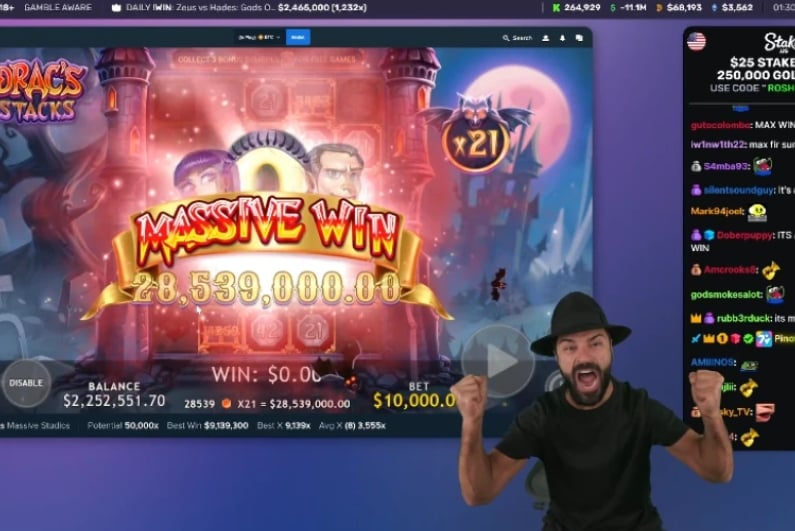
Lets take a look at one of the latest editions of Big Win Wednesday for reference. At the end of February, Roshtein won a staggering $20,000,000 on Drac’s Stacks by Massive Studios. It’s an impressive total, but perhaps you might be less impressed to learn that the Swedish-born streamer wagered $4,000 per spin to bag that win.
It’s not an entirely new phenomenon either, the numbers have been rising over the past year. In fact, Trainwreckstv broke the record for the biggest online slot win of all time last year when he won $37,500,000 on Massive Studios’ Hex Appeal. He did so by staking $6,000 per spin.
His record didn’t stand for long though. It was beaten within a week, and who by? You guessed it. Roshtein secured $45,405,100 on Drac’s Stacks thanks to his eye-watering stakes of $10,000 per spin. Train called out Roshtein at the time for gambling with a fake balance, but his own $6,000 stakes also seemed to blur the line between fact and fiction.
high stakes began to creep in, including bets of up to $1,500 per spin
If we take a look back at Roshtein’s slot bet sizes, there is a clear upward trajectory. During his Twitch years (2019 to 2020) he bet low to medium-sized stakes, from tens to hundreds of dollars per spin. When he secured Stake sponsorship from 2021 to 2022, high stakes began to creep in, including bets of up to $1,500 per spin.
When Kick launched in 2022, the stakes grew too. Multi-thousand dollar spins became normal on the new Stake-backed streaming platform, with stakes ranging anywhere from $600 to $4,000 per spin. However, it wasn’t until 2025 that those stakes really hit the stratosphere. While multi-hundred dollar spins still play a part, stakes can range from $5,000 to $10,000 per spin.
The streamers compared
As I’ve mentioned, Roshtein isn’t alone in this. All of the major gambling streamers are upping the ante when it comes to bet sizes. Below is how the three top gambling streamers, Xposed, Roshtein, and Trainwreckstv, compare over the years in terms of their higher bet ranges:
Streamers (2019–2025)
| Period | Roshtein | Trainwreckstv | Xposed |
| 2019–2020 (early Twitch era) | $50–$200 | $200–$500 | $10–$100 |
| 2021–2022 (Twitch gambling boom) | $200–$1,500 | $500–$2,000 | $100–$500 |
| 2023–2024 (Kick / crypto-casino era) | $600–$4,000 | $1,000–$4,000 | $250–$1,000 |
| 2024–2025 (record-bet era) | $5,000–$10,000 | $3,000–$6,000 | $500–$2,000 |
Fake money
Now we have established there is definitely an upward trajectory, it’s important to establish whether there is any truth behind those numbers. Train is one the biggest names in the gambling space, and he has been very vocal about the damaging role of fake money deals and the lack of transparency around such partnerships.
Roshtein is chief among those accused of engaging in such deals. When Train called him out after his record win, it wasn’t just out of anger that he’d been bested. It was because Train believed Rosh had beaten his record by using fake money. Fellow streamer AverageAden shared the same viewpoint, explaining the criticism in an X post in which he dubbed the streamer a “fraudulent leach”:
While there might be plenty of evidence suggesting that Roshtein is faking it, such as an old streaming clip that showed him playing in demo mode with the same balance as his real account, he has always vehemently denied the accusations. What we do know is that he, like many other streamers, has a sponsorship and affiliate partnership with Stake, of which the terms are not publicly disclosed. But that is not strange in the world of gambling streaming.
In fact, Train has been more public about the terms of his own deal with Stake. He claimed in a live stream that he earned roughly $360m in about 16 months with Stake’s sponsorship. In early 2022 he also told a viewer that he earns “much more” than $1m per month. That stacks up given that the total over 16 months would amount to around $22.5m per month.
Since Train has 510,000 viewers on Kick, and Roshtein around 377,000, it is logical to assume Rosh earns slightly less.
Do the numbers add up?
To assess the possibility of streamers using their own cash for these high-stakes sessions, let’s take the extreme example: Roshtein’s $10,000-per-spin gambling session.
If Roshtein spun 500 times in that session, the total wagered would amount to $5,000,000. If the average return to player (RTP) is 96% on those spins, he would lose around $200,000 per stream, although this would vary widely in practice.
the expected loss would be roughly $4m monthly
Streaming around 20 times per month at those stakes, his expected loss would be roughly $4m monthly. If he were earning anything close to the levels publicly claimed by some gambling streamers – such as Train – it is not entirely outside the realm of possibility that such losses could be sustained with personal funds.
The reason people still suspect casino funding is that streamers almost never risk that much of their own net worth consistently, especially on something as volatile as gambling. Casino sponsorships are known to include large promotional bankrolls or bonus balances. At the end of the day, it also makes business sense: entering a deal with a casino allows the streamer to create the same high-stakes spectacle for viewers while reducing the risk to their own personal wealth.
Without transparency around the exact terms of these sponsorships, it’s difficult to know exactly how much of the money on screen belongs to the streamer and how much may be part of the promotional arrangement. What is clear is that the stakes are increasing, and they don’t show any signs of slowing down anytime soon.